Twitter(X) Launches Its National Label Program — But Korea Remains Silent
In early December 2025, social media platform X (formerly Twitter) ignited a worldwide debate with the rollout of its “National Label Program.” The system analyzes an account’s activity location, language, and network patterns to automatically label whether it may be linked to a specific government or organization — a move presented as an effort to enhance transparency in information sources.
However, what began as a transparency initiative has quickly evolved into a controversy over free expression, censorship, and political neutrality. Supporters claim the program is a necessary measure to combat state-sponsored disinformation and political propaganda, while critics warn it effectively turns X into an unofficial arbiter of truth, deciding which voices deserve credibility and which do not.
In particular, discussions surrounding feminism, politics, and ideology-driven narratives have become flashpoints, as certain accounts labeled under the system face targeted harassment or suppression. For many observers, the core question is whether this new policy represents genuine transparency — or a digital form of ideological tagging.
A Global Experiment in Transparency and Control
Major international media outlets and academic commentators describe X’s new system as a test of credibility in the information age.
As social platforms evolve from communication tools into de facto gatekeepers of truth, the question of “who defines accuracy and by what standard” is no longer technological but deeply democratic in nature.
Some countries have already reported using these new labels to trace coordinated political messaging or disinformation campaigns.
Yet others caution that the same mechanism can be used to silence dissent or categorize inconvenient opinions under the guise of transparency. As a result, the global discourse has split between those who see the initiative as a defense against information warfare and those who fear it as a sophisticated new layer of algorithmic censorship.
Korea’s Silence — A Debate That Never Began
While the issue has dominated global media, Korea remains strikingly silent.
Major broadcasters, online portals, and newspapers have offered no official coverage, and no political figure has yet addressed the matter publicly.
Within Korea, conversations about X’s national labeling system are confined largely to online communities and YouTube discussions.
Interestingly, several tech and civic forums have begun debating whether Korea’s own platforms — such as Naver or Daum — should adopt a similar transparency label, especially given their overwhelming influence in shaping national discourse.
Proponents argue that if transparency is the goal, local platforms should disclose potential political or institutional affiliations that may influence algorithmic news exposure. Opponents, however, warn that such a move could undermine free expression, turning domestic portals into extensions of political oversight. The discussion remains polarized — framed once again between freedom and accountability, openness and control. Despite this growing online chatter, Korea’s mainstream media has remained entirely disengaged. Some analysts suggest this is not mere indifference but a sign that Korean media structures have yet to adapt to global debates on digital transparency. Others note that political sensitivities surrounding platform regulation may have discouraged open coverage altogether.
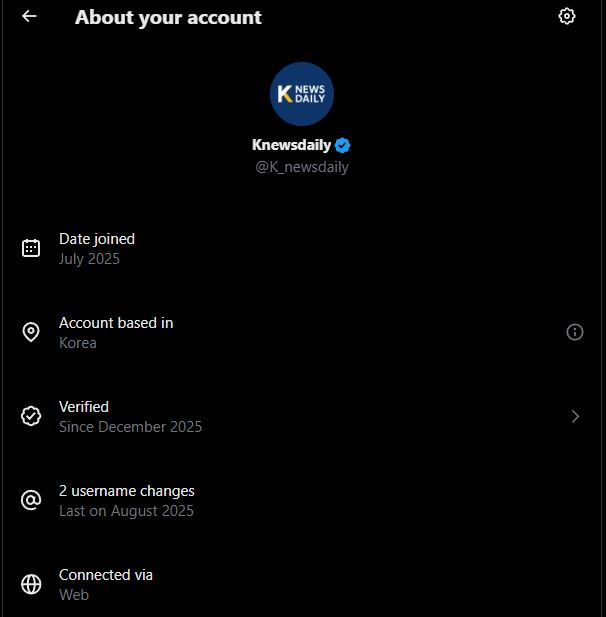
In the Twitter app, the user’s nationality is displayed directly on their profile, while on the PC version, it can be viewed by clicking the account’s join date. (KNEWSDAILY is identified as a Korea-based account.)
The Age of Algorithmic Accountability — Where Does Korea Stand?
The essence of this controversy extends beyond X itself. It raises a deeper question about how societies define credibility, trust, and accountability in an era when every individual, corporation, and government can act as a media outlet.
Transparency is essential — yet it comes with the risk of transforming into surveillance disguised as openness. X’s “National Label Program” may be the first real-world experiment testing that fragile boundary. And while the world debates where the line between freedom and control should be drawn, Korea remains outside that conversation — silent, observant, and uncertain. Whether that silence stems from disinterest or from something far more complex, no one truly knows.
[ Peter Kim, Korea-based journalist ]
Join the Discussion Share your take with the community →




 wpDiscuz