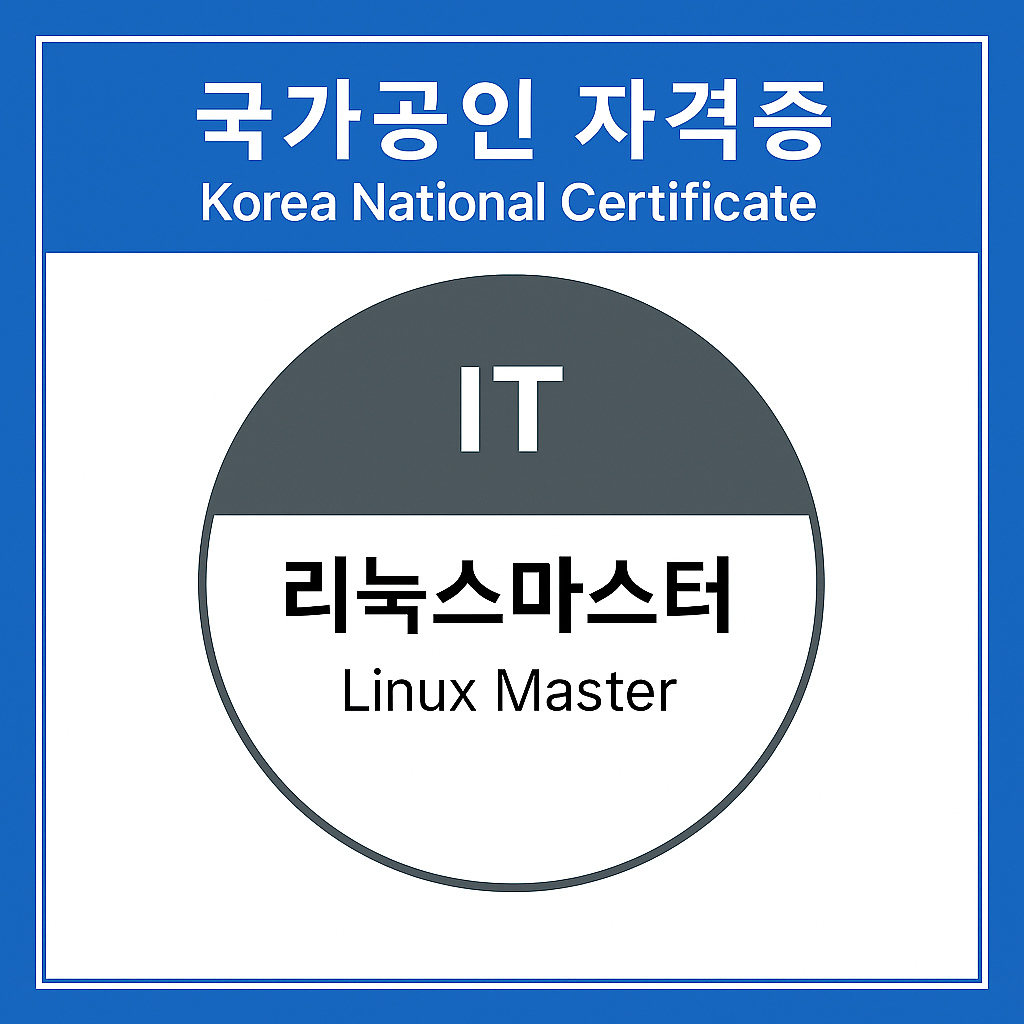
The Linux Master is a national certification managed by the Korea Information and Communication Promotion Association (KIPA), composed of two levels (Level 1 and Level 2), with a written and practical test format, focusing on the ability to manage Linux systems and networks; it is held three times a year and is highly regarded for server and infrastructure-related careers.
Linux Master?

The Linux Master Certification is a national qualification administered by the Korea Information and Communication Promotion Association (KIPA), aimed at evaluating practical proficiency in managing Linux operating systems. It is divided into two levels: Level 2 targets beginners, assessing basic Linux commands, user and file system management, and fundamental networking concepts, while Level 1 is designed for intermediate to advanced users, testing knowledge in security, server configuration, shell scripting, network operation, and troubleshooting skills. Both levels consist of written and practical tests. The written portion includes multiple-choice and short-answer questions, and the practical exam includes scenario-based or descriptive problem-solving tasks in simulated environments. The test content reflects up-to-date Linux distributions and practical usage trends, referencing systems like Red Hat, CentOS, and Ubuntu. Examinees are expected to have hands-on experience with Linux, understand shell command flow and system logs, and grasp basic network services. Level 1, in particular, demands a high degree of operational capability and is often considered essential for careers in system administration. The exam is offered three times a year, and the registration fee varies depending on the level. The certification is widely recognized in fields such as server management, cloud infrastructure, DevOps, and security operations, serving as a practical benchmark of expertise.
Editor’s Opinion

If you're aiming to work in system infrastructure, server administration, or DevOps roles, the Linux Master certification is a solid and credible credential to acquire. While not always mandatory, many Korean companies—especially in IT services and public sectors—see it as proof of practical system management skills. Compared to Linux Professional Institute Certifications (LPIC), the Linux Master is more tailored to domestic use cases and aligns better with Korean enterprise environments. If you are planning to move into cloud or backend engineering, passing at least the Level 2 exam is recommended, and Level 1 will provide a competitive edge in technical interviews.
Disclaimer: The following article presents an overview of current government policy and is not intended as political support or criticism.President Lee Jae-myung has recently introduced a public stimulus initiative known…
South Korea’s Financial Supervisory Service (FSS) has recently advised domestic asset management firms to refrain from excessively including cryptocurrency-related stocks, such as Coinbase and MicroStrategy, in their exchange-traded fund (ETF)…
Warning: This article does not constitute investment advice. Any losses incurred are your responsibility. A Rally from the Depths of Fear As of October 14, 2025, the crypto market finds…
!!! Warning: This article does not constitute investment advice. Any trading losses are the responsibility of the investor. !!! Market Overview — Fear Persists Amid a Weak Recovery Bitcoin has…
Korea today faces one of the world’s most dramatic demographic transitions. For many years, experts have warned that the country’s low birth rate and rapid population aging could reshape its…
Overview “Typhoon Company” is a Korean drama released on October 11, 2025, streaming simultaneously on Netflix and TVING.Set during the 1997 IMF financial crisis, the series follows Tae-poong (played by…
To provide the best experiences, we use technologies like cookies to store and/or access device information. Consenting to these technologies will allow us to process data such as browsing behavior or unique IDs on this site. Not consenting or withdrawing consent, may adversely affect certain features and functions.
Functional
Always active
The technical storage or access is strictly necessary for the legitimate purpose of enabling the use of a specific service explicitly requested by the subscriber or user, or for the sole purpose of carrying out the transmission of a communication over an electronic communications network.
Preferences
The technical storage or access is necessary for the legitimate purpose of storing preferences that are not requested by the subscriber or user.
Statistics
The technical storage or access that is used exclusively for statistical purposes.The technical storage or access that is used exclusively for anonymous statistical purposes. Without a subpoena, voluntary compliance on the part of your Internet Service Provider, or additional records from a third party, information stored or retrieved for this purpose alone cannot usually be used to identify you.
Marketing
The technical storage or access is required to create user profiles to send advertising, or to track the user on a website or across several websites for similar marketing purposes.