Disclaimer: The following article presents an overview of current government policy and is not intended as political support or criticism.

President Lee Jae-myung has recently introduced a public stimulus initiative known as the “Public Relief Consumption Coupons” to revitalize domestic consumption and support everyday citizens amid prolonged economic stagnation. These coupons are either distributed universally or targeted to specific groups such as low-income households, the elderly, or families with children, and can be used in key consumer sectors like dining, culture, tourism, traditional markets, and small businesses. The policy aims to achieve a twofold effect: invigorating consumer demand while also providing practical aid to vulnerable populations.

This type of economic stimulus is not entirely new in Korea. During the COVID-19 pandemic, similar coupon programs had a measurable short-term impact. They helped boost household spending and temporarily uplifted struggling industries. Furthermore, the transition from paper coupons to digital formats such as prepaid cards or mobile apps has increased accessibility, transparency, and convenience. These advantages have earned favorable responses from the public.

However, several concerns remain. Critics argue that the effect may be uneven, benefitting only select sectors while neglecting broader structural issues. Some economists caution that such programs may not address deeper challenges like youth unemployment, stagnant wages, or the widening gap between large corporations and SMEs. Others question the long-term sustainability of continuing such policies, particularly in light of Korea's aging population and growing fiscal burden. There are also political debates about whether these measures are merely populist tactics or genuine welfare policies.

Ultimately, the effectiveness of the Public Relief Consumption Coupons will be judged not just by short-term spending data but by how well they address the public’s daily needs and restore confidence in the economy.

What do you think?
My Take:
A commonly raised criticism is that although the policy was designed to support small businesses and boost the local economy, it has not significantly altered consumer behavior. Instead of encouraging new or additional spending, the coupons are often used to cover existing daily expenses, resulting in minimal impact on overall consumption patterns.

While promotional materials suggest scenarios like “gathering the whole family for a special dinner using the coupons,” such narratives may reflect an outdated perspective more fitting for the 20th century. In reality, most people simply apply the coupons to routine purchases such as lunch.

Like any policy, the public relief coupons come with both advantages and limitations.
* Spoilers are separated at the end, so feel free to read the intro without any worry. The Great Flood is a Korean SF disaster film set in the near future, depicting a world destabilized by an unprecedented, large-scale flood. Rather than focusing on the scientific cause of the catastrophe, the film centers on how…
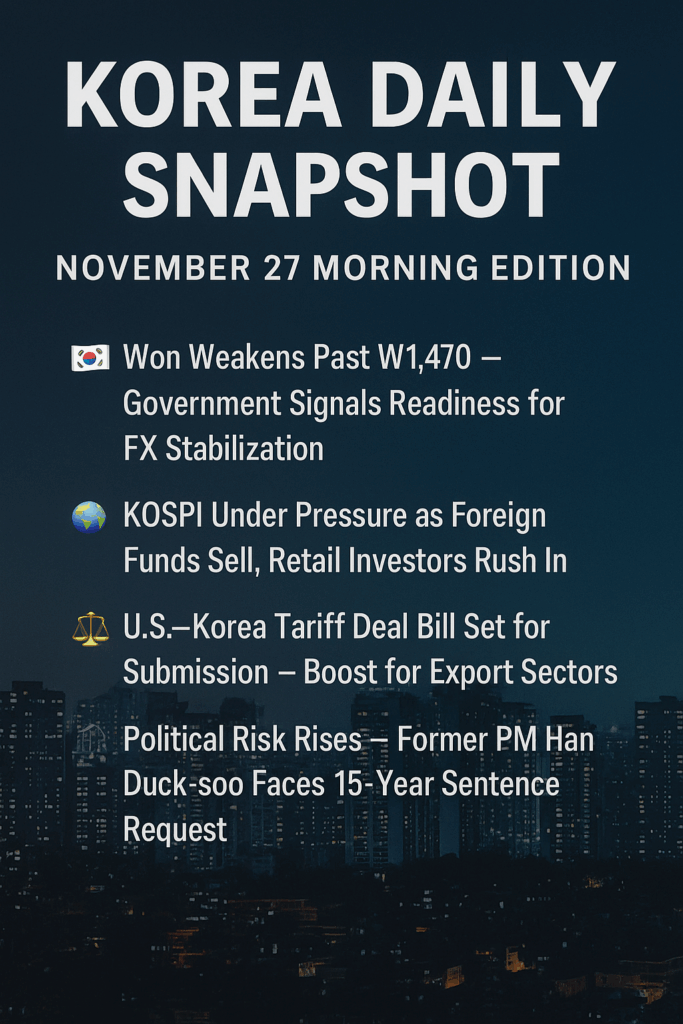
** Rising Market Volatility, Policy Uncertainty, and Currency Pressure Define the Day ** Image1. U.S. dollar / South Korean chart (Trading View) Won Weakens Past ₩1,470 — Government Signals Readiness for FX Stabilization The Korean won briefly crossed the ₩1,470 per U.S. dollar threshold on Tuesday, marking its weakest level in months. The government swiftly…
South Korea’s retail investors are showing a clear trend of concentrating on the KOSPI market again.According to the Korea Securities Depository, in the first half of 2024, individual investors’ net purchases of KOSPI stocks totaled approximately 35 trillion KRW, marking a year-on-year increase of over 20%.Experts note that while last year many retail traders favored…
⚠️ This article is for informational purposes only and does not constitute legal advice.Foreigners living in Korea are subject to the same criminal laws as Korean nationals. Whether the issue is theft, assault, drug offenses, or drunk driving, foreign residents and visitors are bound by the Korean Criminal Act and related legislation. However, when foreigners…
OriginHey, I’m Solana, the high-speed blockchain built for the modern world.I was born in 2020, founded by Anatoly Yakovenko, a former Qualcomm engineer who believed blockchains could be as fast as the Internet itself. My birthplace? The sunny coast of California, where the dream was simple: speed, scalability, and accessibility.While others relied on slow confirmation…
Summary of Major CertificatesPCCE is a private entry-level certificate designed for beginners, focusing on simple syntax and output-based coding problems.PCCP is a private certification test hosted by Programmers, featuring practical algorithm-based problems to evaluate real-world coding skills.COS PRO, managed by YBM, is a procedural coding test categorized into beginner and intermediate levels, mainly using C…
To provide the best experiences, we use technologies like cookies to store and/or access device information. Consenting to these technologies will allow us to process data such as browsing behavior or unique IDs on this site. Not consenting or withdrawing consent, may adversely affect certain features and functions.
Functional
Always active
The technical storage or access is strictly necessary for the legitimate purpose of enabling the use of a specific service explicitly requested by the subscriber or user, or for the sole purpose of carrying out the transmission of a communication over an electronic communications network.
Preferences
The technical storage or access is necessary for the legitimate purpose of storing preferences that are not requested by the subscriber or user.
Statistics
The technical storage or access that is used exclusively for statistical purposes.The technical storage or access that is used exclusively for anonymous statistical purposes. Without a subpoena, voluntary compliance on the part of your Internet Service Provider, or additional records from a third party, information stored or retrieved for this purpose alone cannot usually be used to identify you.
Marketing
The technical storage or access is required to create user profiles to send advertising, or to track the user on a website or across several websites for similar marketing purposes.