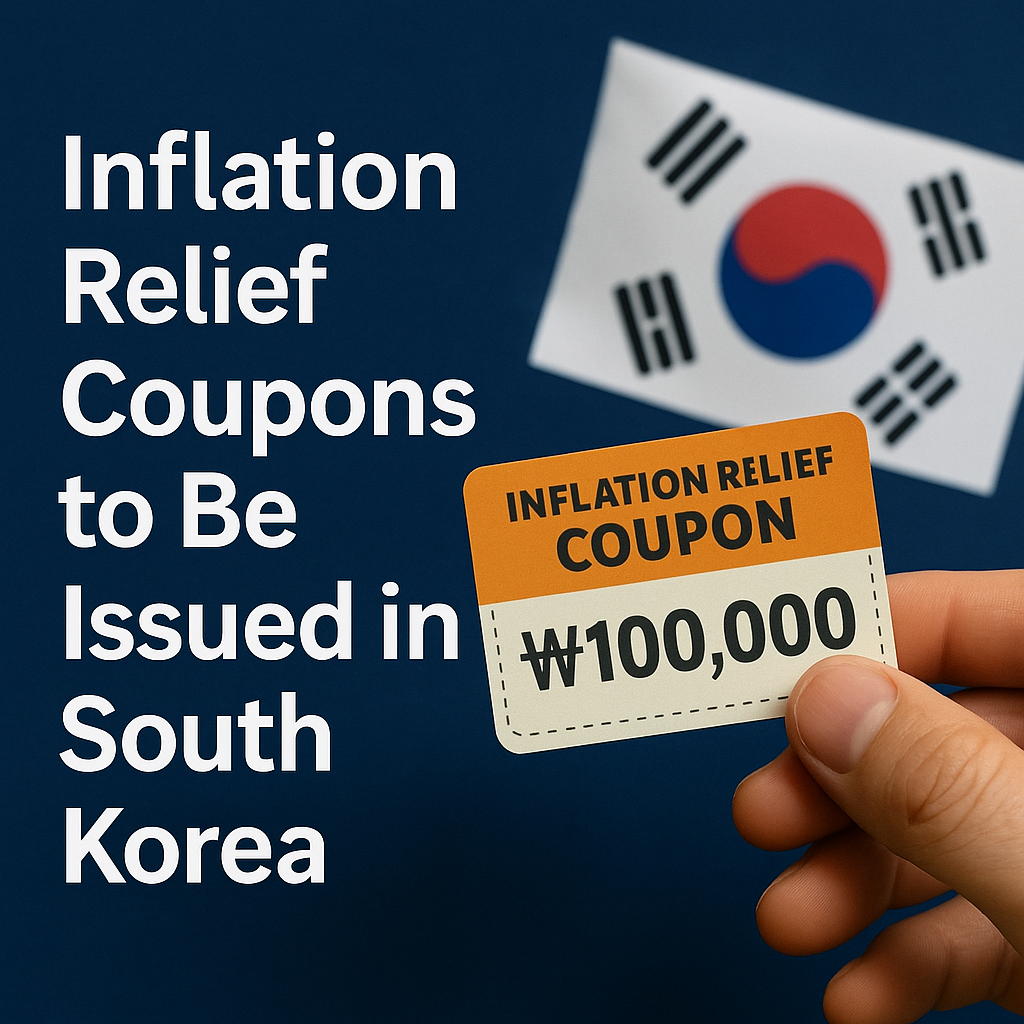
The South Korean government officially launched its “Public Relief Coupon Program” this week, aiming to boost consumer spending and help citizens cope with rising living costs.

The program, announced by the Ministry of Economy and Finance, provides households with discount coupons and purchase subsidies for essential goods, cultural events, local markets, and travel. It is part of a broader initiative to stabilize the post-pandemic economy and invigorate stagnant consumption.

Under the plan, eligible households can receive up to 300,000 KRW ($220) in coupons, depending on income level and family size. The coupons can be used both online and offline, with priority given to small businesses and local vendors. The government expects the program to benefit over 15 million people nationwide.

According to officials, the first phase of distribution begins this week, starting with childcare support vouchers and cultural activity coupons. The Ministry stated that "this initiative is designed to inject vitality into local economies and offer relief to struggling families."

However, critics argue that the program may have limited long-term effect and could place a fiscal burden on the state. Some economists warn that increased government spending could lead to inflationary pressure or require future tax hikes.
My Take
Providing government-issued spending coupons may offer short-term relief, but it inevitably comes with long-term consequences—especially in the form of taxation. While such programs may encourage consumption, the ongoing public debate in South Korea reflects a deeper concern: who ultimately bears the cost of temporary economic stimulus?
If you are reading this article, you are probably feeling very confused and stressed because you suddenly started hearing tinnitus. However, the fact that you responded immediately upon discovering it…
South Korea is one of the most frequently asked-about destinations when it comes to safety. According to the Global Peace Index 2024, South Korea ranked among the top 20 safest…
[Korea Economy] South Korea’s National Pension Service (NPS) has entered renewed discussions on expanding its strategic foreign-exchange hedging as the won continues to trade at elevated levels against the U.S….
While the market that is currently in the spotlight is rapidly changing, long-term investment is considered rather than short-term investment, and the scale is large. However, simply maintaining a grip…
[Summary]”84 Square Meters” follows the story of Woo-sung (played by Kang Ha-neul), a young man who pours everything he has into purchasing an 84㎡ apartment. To keep up with the…
The New Glow in China: Why Korean Beauty Is Rising Again If you look at the beauty shelves in Shanghai, scroll through Xiaohongshu, or watch the latest livestreams from China’s…
To provide the best experiences, we use technologies like cookies to store and/or access device information. Consenting to these technologies will allow us to process data such as browsing behavior or unique IDs on this site. Not consenting or withdrawing consent, may adversely affect certain features and functions.
Functional
Always active
The technical storage or access is strictly necessary for the legitimate purpose of enabling the use of a specific service explicitly requested by the subscriber or user, or for the sole purpose of carrying out the transmission of a communication over an electronic communications network.
Preferences
The technical storage or access is necessary for the legitimate purpose of storing preferences that are not requested by the subscriber or user.
Statistics
The technical storage or access that is used exclusively for statistical purposes.The technical storage or access that is used exclusively for anonymous statistical purposes. Without a subpoena, voluntary compliance on the part of your Internet Service Provider, or additional records from a third party, information stored or retrieved for this purpose alone cannot usually be used to identify you.
Marketing
The technical storage or access is required to create user profiles to send advertising, or to track the user on a website or across several websites for similar marketing purposes.



![[Korea Economy] Can the National Pension Service’s 10% Strategic FX Hedge Really Contain a Weak Won?](https://knewsdaily.com/wp-content/uploads/2025/12/Korea-Economy-Can-the-National-Pension-Services-10-Strategic-FX-Hedge-Really-Contain-a-Weak-Won-1.png)



😂😂😂😂😂