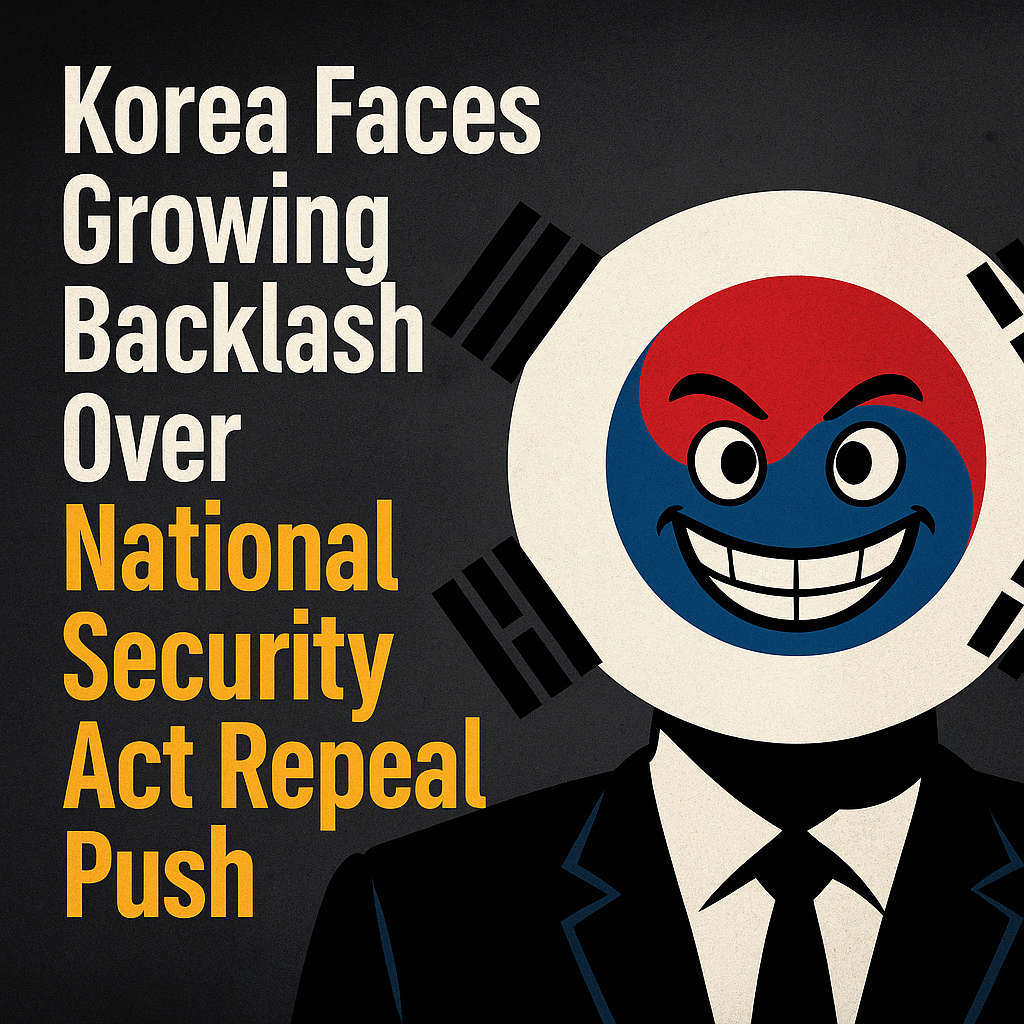
Korea Faces Growing Backlash Over National Security Act Repeal Push
(K-News Daily / Political Analysis by Peter Kim, Korea-based journalist)
South Korea is now facing a wave of public backlash following the recent parliamentary move to repeal the National Security Act (NSA) — a decades-old law originally enacted in 1948 to protect the nation from anti-state activities during the early Cold War. What began as a symbolic reform proposal has quickly evolved into one of the most polarizing political issues of late 2025.
From Proposal to Controversy
In early December, a group of 31 lawmakers, mainly from opposition and reformist parties, introduced a bill seeking to abolish the NSA altogether. Their argument: the law is outdated, authoritarian in origin, and inconsistent with modern democratic values. However, since the proposal’s submission, the public response has been overwhelmingly critical. The national legislative portal — where citizens can submit comments — has recorded tens of thousands of entries opposing the repeal, far outpacing those in support. Many citizens argue that while reform may be needed, full abolition would leave the country vulnerable to espionage and ideological subversion.
As one commenter summarized, “You can’t talk about freedom without first ensuring security — freedom collapses when safety is gone.”
Why the National Security Act Still Divides Korea
The National Security Act criminalizes activities considered “anti-state,” including support for or contact with North Korean organizations, dissemination of pro-North materials, and unauthorized sharing of classified information. Supporters of the repeal argue that these clauses have long been used to suppress dissent and free speech, especially during Korea’s authoritarian past. Critics counter that even in today’s digital era, cyber operations, propaganda infiltration, and espionage remain active threats — making a security framework essential.
The divide reflects Korea’s dual identity: a democratic, globally connected economy still living under the shadow of an unresolved war and geopolitical tension.
The Numbers Behind the Debate
– Lawmakers proposing repeal: 31 (Opposition + Minor reformist blocs)
– Public comments opposing repeal (as of Dec 10): Over 90,000 (Legislation Portal)
– Majority stance in National Assembly: Still against full repeal; talks of partial amendment or modernization instead
– Next step: Legislative committee review and constitutional review procedure before any plenary vote
While the repeal bill has drawn symbolic support from progressive circles, it faces near-certain rejection without cross-party compromise. Even moderates within the opposition have urged caution, citing “social division and external misinterpretation risks.”
Public Mood — ‘Not Yet, Not This Way’
Online discussions and civic forums reveal that most Koreans are not against reforming the NSA — they simply oppose abolishing it outright.
Common sentiments include:
– “We can’t dismantle our security laws while cyberattacks and disinformation are increasing.”
– “If there’s abuse, fix the law — don’t delete it.”
This perspective aligns with the nation’s collective memory: past incidents of espionage, digital hacking, and ideological conflict continue to shape public caution.
Looking Ahead — Reform vs. Repeal
Experts expect the issue to remain a key flashpoint heading into 2026. While human rights advocates call for a complete repeal aligned with international norms, security analysts emphasize the need for a gradual, carefully defined reform process. For now, the government’s official stance remains “cautious deliberation.” The Ministry of Justice has stated that “national security and civil liberties must be balanced through social consensus,” signaling that Korea’s legislative process will likely lean toward revision, not revolution.
Editor’s Note
Korea’s National Security Act has long stood at the intersection of fear and freedom — a relic of war, yet a safeguard for peace. The growing resistance to its repeal reveals not just political division, but the Korean public’s deep-seated awareness of history and risk. The challenge ahead will be finding a version of security law that reflects a confident democracy — neither paralyzed by fear, nor careless about freedom.
— Peter Kim, Korea-based journalist
Join the Discussion Share your take with the community →