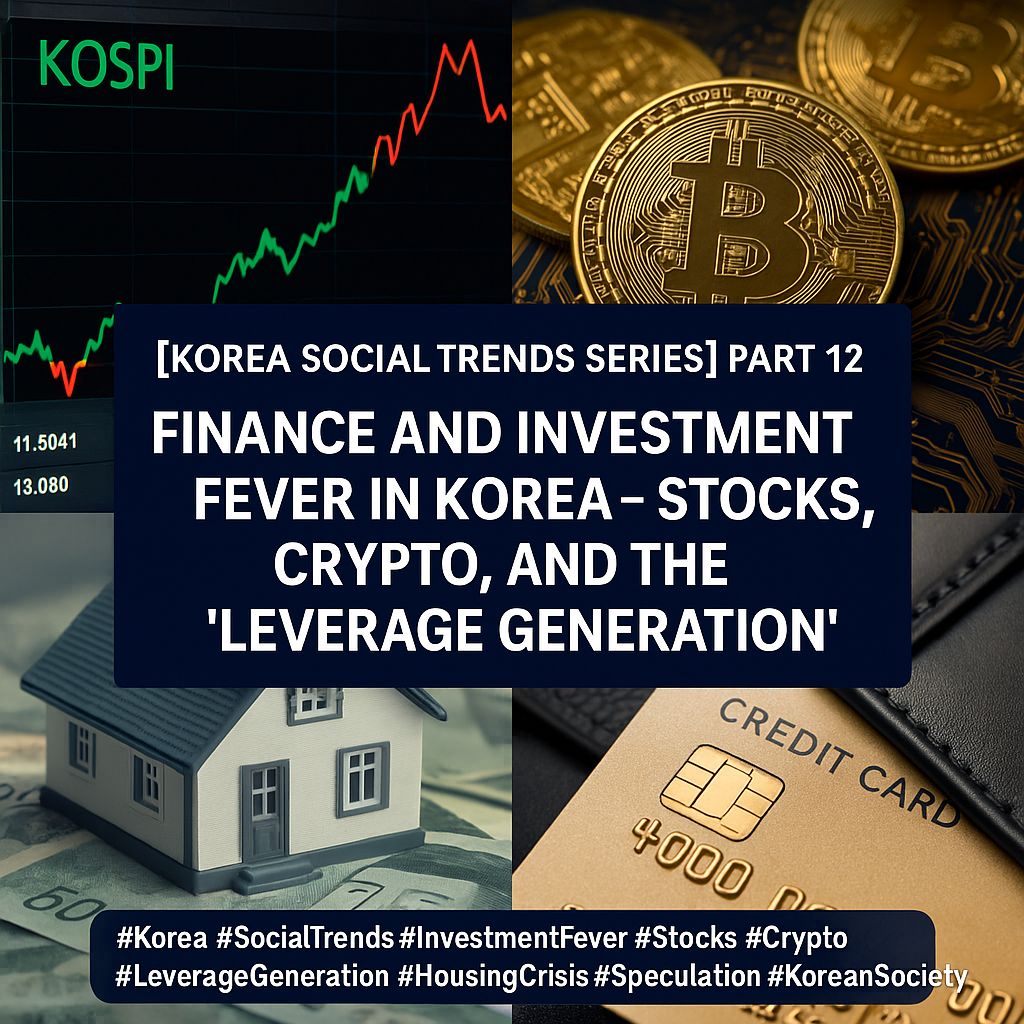
In recent years, Korea has witnessed an extraordinary surge in public interest in finance and investment, particularly among young people. From traditional stock markets to cryptocurrencies and real estate-related financial products, investment has become not only an economic activity but also a cultural phenomenon. This wave is often described with terms such as “영끌” (using every bit of financial leverage to invest) and “빚투” (borrowing money to invest), reflecting the lengths to which individuals are willing to go in pursuit of returns. For foreign readers, Korea’s finance and investment fever offers a unique lens into the aspirations, anxieties, and structural challenges facing one of Asia’s most dynamic economies.

1. Historical Context of Investment Culture in Korea
Korea’s investment culture is rooted in rapid economic development and collective memory of financial crises. The Asian Financial Crisis of 1997 and the Global Financial Crisis of 2008 left deep scars, instilling both fear and determination in the public psyche. Many Koreans came to believe that relying solely on wages is not enough to secure a stable future. This conviction grew stronger as wage growth stagnated and housing prices soared, pushing ordinary people to seek wealth through financial markets. As a result, investment became a central part of everyday conversations, media content, and even pop culture.

2. Stock Market Participation Boom
The Korean stock market has seen a dramatic influx of retail investors, particularly during the COVID-19 pandemic. With travel and entertainment restricted, many young people turned to stock trading, often through easy-to-use mobile apps. This surge created the so-called “동학개미운동” (Donghak Ant Movement), where retail investors collectively bought shares to protect domestic companies from foreign investors. By 2021, retail investors accounted for over 70% of daily trading volume in the Korean stock exchange.
For many, stock trading is not just about returns but also about national pride and generational identity. However, this enthusiasm has also led to risky behavior, with inexperienced investors chasing short-term gains in volatile markets.

3. Cryptocurrency Mania
Korea has also emerged as a global hotspot for cryptocurrency trading. Exchanges like Upbit and Bithumb became household names, and at one point, Korea accounted for nearly 20% of global Bitcoin transactions. For many young Koreans, crypto represents both opportunity and desperation—a chance to break free from traditional economic constraints and leap into wealth.
The volatility of crypto markets, however, has created painful losses as well as spectacular gains. Stories of individuals becoming millionaires overnight are matched by stories of others losing life savings. Regulatory debates continue, with the government struggling to balance innovation with investor protection.

4. Real Estate as Financial Asset
Housing has long been the cornerstone of wealth in Korea, but skyrocketing real estate prices have made ownership increasingly unattainable for younger generations. This has fueled resentment and intensified the drive toward alternative investments. Terms like “전세 난민” (jeonse refugees) describe young couples unable to secure housing under the unique Korean lease system.
Real estate-related financial products, such as REITs and mortgage-backed securities, have gained traction as indirect ways to participate in the housing market. Yet these too are seen as out of reach for those without substantial capital, reinforcing perceptions of inequality.

5. The Leverage Generation
The terms “영끌” and “빚투” symbolize a new generation of investors who are willing to stretch their finances to the limit in pursuit of opportunity. Low interest rates encouraged borrowing, while social media amplified success stories, creating a sense of urgency and fear of missing out (FOMO). A 29-year-old office worker might take out multiple loans to invest in stocks or crypto, hoping for returns that will allow them to buy an apartment—a dream increasingly out of reach through salary alone.
While some succeed, others face crushing debt, highlighting the precarious nature of Korea’s investment fever.

6. Social Implications – Stress and Inequality
The culture of aggressive investing has profound social implications. On one hand, it reflects ambition and adaptability; on the other, it reveals deep insecurity and systemic inequality. Wealthier individuals can absorb risks and access safer investment channels, while younger and less affluent investors bear the brunt of volatility. Mental health issues, including stress and depression, are reported among those who suffer heavy losses.
The generational divide is also stark. Older Koreans, who benefited from rising property values, are often contrasted with younger generations trapped in debt and speculative markets. This divide feeds into broader social tensions and political debates about fairness and opportunity.

7. Financial Media and Pop Culture
Investment fever permeates Korean media and culture. YouTube channels offering stock tips attract millions of followers, while TV dramas and webtoons depict characters chasing financial success. Even casual conversations among friends frequently involve stock tickers, crypto prices, or housing markets. Finance has become not just an economic activity but a lifestyle marker and a shared cultural language.

8. Government Regulation and Future Outlook
The Korean government has responded with tighter regulations on loans, efforts to stabilize housing markets, and proposals to regulate cryptocurrencies. Critics argue that these measures sometimes exacerbate frustrations, as they restrict access without addressing underlying structural issues. Looking ahead, the challenge for Korea is to foster sustainable financial markets that provide genuine opportunities without fueling speculative bubbles. The rise of ESG (Environmental, Social, and Governance) investing and digital finance platforms may offer new directions, but whether these can relieve structural pressures remains uncertain.

9. Everyday Examples
Consider a 27-year-old university graduate who spends nights monitoring crypto markets, hoping to turn a modest investment into the down payment for an apartment. Or a middle-aged office worker who juggles stock trading during lunch breaks while worrying about mortgage debt. These stories highlight the ubiquity of investment fever in everyday Korean life, cutting across generations and income levels.

10. Looking Ahead
Korea’s finance and investment fever captures both the dynamism and the fragility of its economy. On one hand, it demonstrates the resourcefulness and drive of its people; on the other, it reveals systemic pressures that make speculative investing seem like the only path to security. For foreign readers, this phenomenon underscores a critical question: how can Korea build a society where wealth accumulation does not depend on extreme leverage and constant risk-taking?
Editor’s Note
Korea’s investment fever highlights the intersection of aspiration and anxiety. It shows a society that has achieved remarkable prosperity but still struggles with inequality, housing insecurity, and financial instability. For outsiders, it offers a vivid example of how cultural values and economic pressures can converge to produce both opportunity and vulnerability. The challenge for Korea will be to channel this energy into sustainable growth without leaving behind those who cannot afford the risks.
(Disclaimer: The following content is an evaluation of current crypto trends and does not constitute investment advice or a financial recommendation.)Bitcoin is approaching the $119,000 mark, while Ethereum hovers near…
The crypto market is showing signs of unease as both Bitcoin and Ethereum experience sharp pullbacks. As of today, Bitcoin is trading around $66,500, a noticeable drop from its weekly…
Bitcoin has surged past the highly anticipated $120,000 mark, setting a new all-time high and igniting bullish sentiment across the entire crypto market. Analysts attribute this rally to strong institutional…
Korea’s remarkable economic rise over the past half-century has been driven largely by rapid urbanization. Cities like Seoul, Busan, and Incheon became engines of growth, drawing millions from rural areas…
OriginHey, I’m Solana, the high-speed blockchain built for the modern world.I was born in 2020, founded by Anatoly Yakovenko, a former Qualcomm engineer who believed blockchains could be as fast…
Over the last two decades, Korea has undergone a remarkable cultural transformation. What began as a regional phenomenon known as the “Korean Wave” or Hallyu has evolved into a full-scale…
To provide the best experiences, we use technologies like cookies to store and/or access device information. Consenting to these technologies will allow us to process data such as browsing behavior or unique IDs on this site. Not consenting or withdrawing consent, may adversely affect certain features and functions.
Functional
Always active
The technical storage or access is strictly necessary for the legitimate purpose of enabling the use of a specific service explicitly requested by the subscriber or user, or for the sole purpose of carrying out the transmission of a communication over an electronic communications network.
Preferences
The technical storage or access is necessary for the legitimate purpose of storing preferences that are not requested by the subscriber or user.
Statistics
The technical storage or access that is used exclusively for statistical purposes.The technical storage or access that is used exclusively for anonymous statistical purposes. Without a subpoena, voluntary compliance on the part of your Internet Service Provider, or additional records from a third party, information stored or retrieved for this purpose alone cannot usually be used to identify you.
Marketing
The technical storage or access is required to create user profiles to send advertising, or to track the user on a website or across several websites for similar marketing purposes.