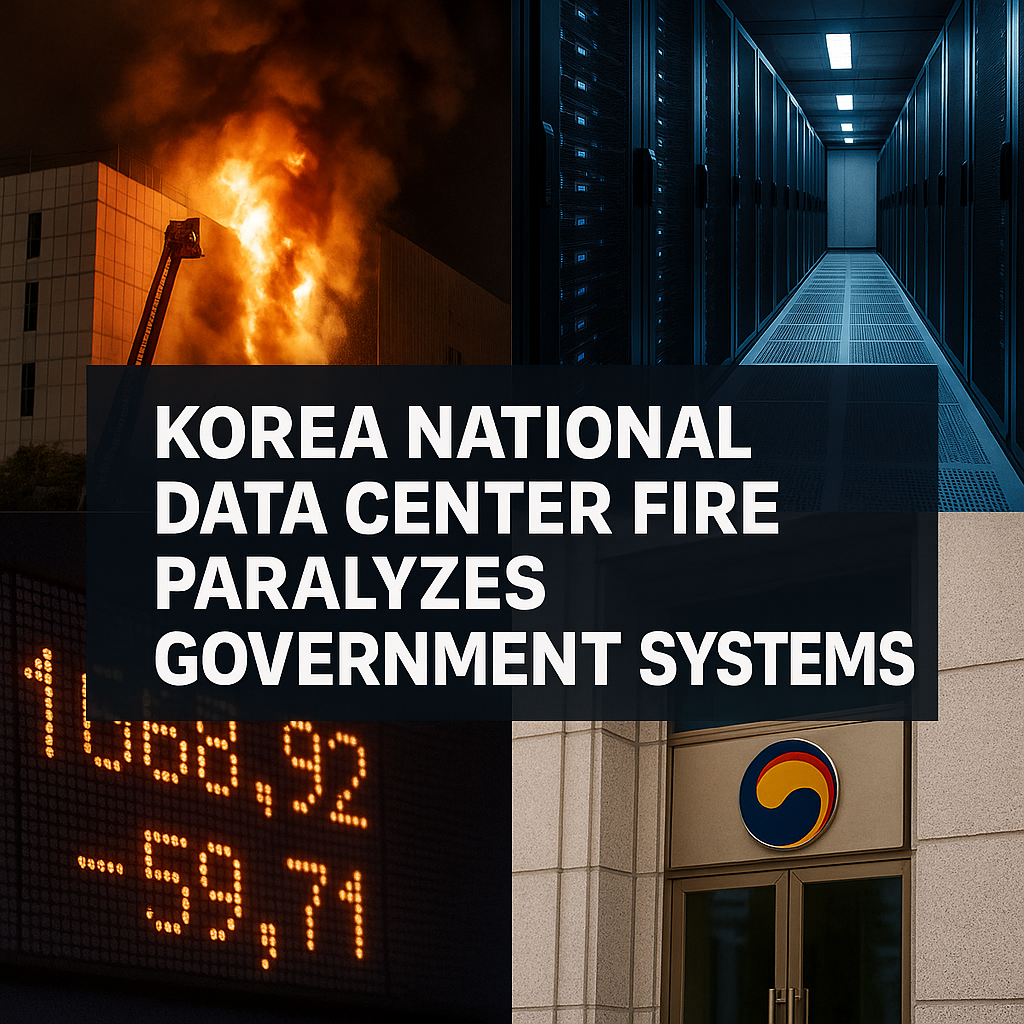
A massive fire broke out at the National Information Resources Service data center in Daejeon on Friday night, crippling a wide range of critical government systems. The blaze is believed to have started with the explosion of lithium-ion batteries in the server room, with overheating and power surges worsening the damage.

Fire authorities reported that the blaze began around 8 p.m. and was not fully extinguished until early the following morning. The response was particularly challenging as traditional firefighting methods were ineffective against battery explosions. Instead, carbon dioxide extinguishers and ventilation were deployed to contain the flames.

The damage was extensive. The center functions as the core of the government’s cloud infrastructure, hosting 647 administrative systems. More than 600 systems were forced offline immediately after the fire, and about 70 were directly damaged. Key public services, including postal banking, electronic petitions, civil service applications, mobile ID systems, and legal databases, were disrupted. Several internal email systems at government ministries were also paralyzed, halting inter-agency communication.

The outage triggered nationwide confusion. Tax filing deadlines were postponed, civil petitions delayed, and certificate issuances suspended. Citizens received emergency text alerts with instructions for alternative service channels, while local post offices reported overcrowding as customers attempted to access offline services.

The government quickly declared an emergency response. President Lee demanded accountability, stating that “it is unacceptable that no contingency systems were in place for such an incident,” and ordered a comprehensive upgrade of data safety and backup infrastructure. Ministries were instructed to establish dual-system redundancy and strengthen disaster-prevention protocols.

Authorities identified lithium-ion battery failure as the likely cause. More than 400 battery packs were recovered for forensic analysis. Fortunately, casualties were minimal, with only one minor injury reported.

Recovery efforts are underway. Of the 647 systems affected, the government aims to restore 551, reporting that 99% of critical security hardware has already been rebuilt. As of September 29, 46 key services—including administrative, postal, and civil systems—had resumed operations.
Editor’s Note
This was not simply a physical accident but a stark warning about the vulnerabilities of Korea’s digital infrastructure. The heavy concentration of essential systems in one central facility maximizes efficiency but also magnifies risks. Backup redundancy, distributed data systems, and robust emergency protocols have long been debated, but this incident tested them in reality—and exposed critical gaps.

For Korean citizens, the fire was a reminder that digital reliability is as vital as physical infrastructure. In a society where data underpins daily life, the shutdown of a single center was enough to disrupt government, business, and personal routines. The lesson is clear: resilience must be built into every layer of digital governance.
In recent years, Korea has witnessed an extraordinary surge in public interest in finance and investment, particularly among young people. From traditional stock markets to cryptocurrencies and real estate-related financial…
!!! Warning: This article does not constitute investment advice. Any trading losses are the responsibility of the investor. !!! A Measured Comeback Above the Half-Line Bitcoin is once again showing…
(K-News Daily / Political Analysis by Peter Kim, Korea-based journalist) South Korea is now facing a wave of public backlash following the recent parliamentary move to repeal the National Security…
South Korea is one of the most frequently asked-about destinations when it comes to safety. According to the Global Peace Index 2024, South Korea ranked among the top 20 safest…
!!! Warning: This article does not constitute investment advice. Any losses incurred are your responsibility. !!! Fear Deepens, Yet 110K Holds Bitcoin is trading near $110K, down roughly 3.8% day-over-day,…
OriginHey, I’m Solana, the high-speed blockchain built for the modern world.I was born in 2020, founded by Anatoly Yakovenko, a former Qualcomm engineer who believed blockchains could be as fast…
To provide the best experiences, we use technologies like cookies to store and/or access device information. Consenting to these technologies will allow us to process data such as browsing behavior or unique IDs on this site. Not consenting or withdrawing consent, may adversely affect certain features and functions.
Functional
Always active
The technical storage or access is strictly necessary for the legitimate purpose of enabling the use of a specific service explicitly requested by the subscriber or user, or for the sole purpose of carrying out the transmission of a communication over an electronic communications network.
Preferences
The technical storage or access is necessary for the legitimate purpose of storing preferences that are not requested by the subscriber or user.
Statistics
The technical storage or access that is used exclusively for statistical purposes.The technical storage or access that is used exclusively for anonymous statistical purposes. Without a subpoena, voluntary compliance on the part of your Internet Service Provider, or additional records from a third party, information stored or retrieved for this purpose alone cannot usually be used to identify you.
Marketing
The technical storage or access is required to create user profiles to send advertising, or to track the user on a website or across several websites for similar marketing purposes.