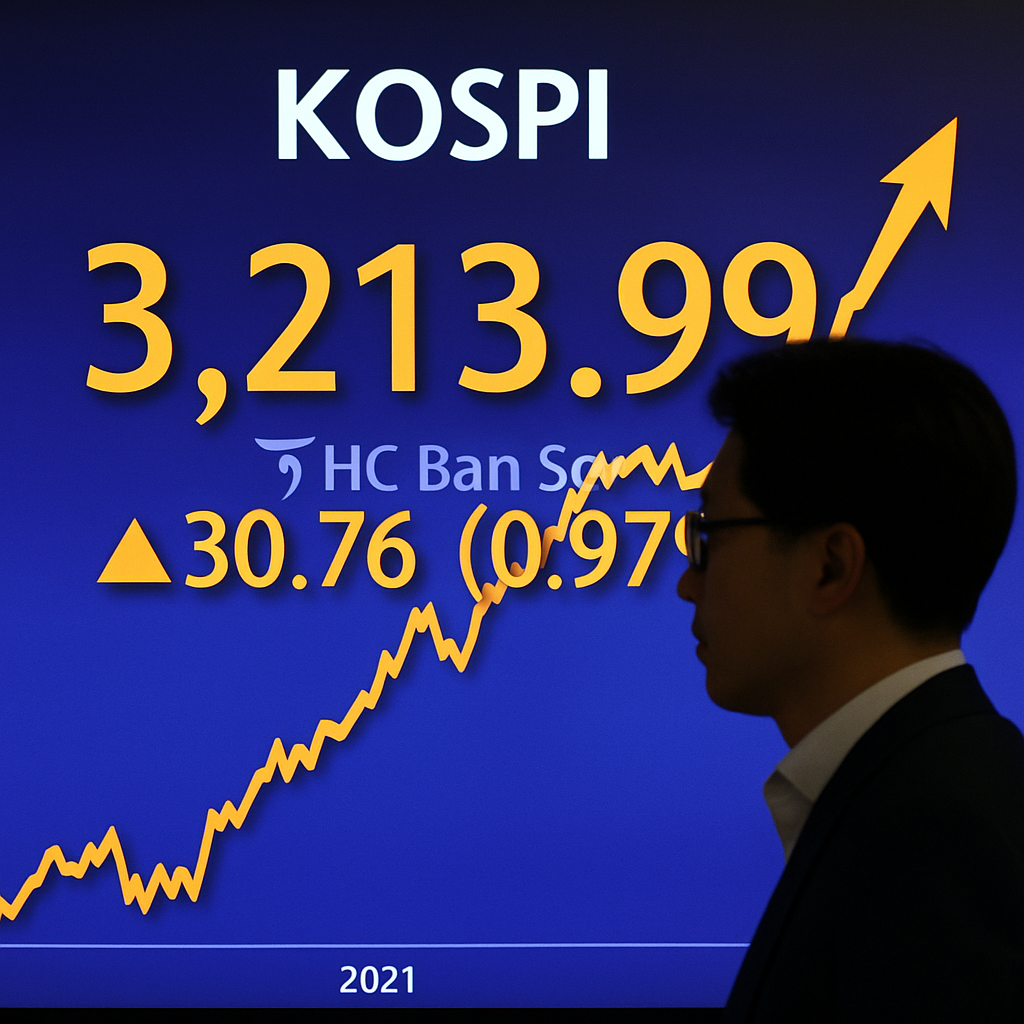
On July 11th, Korea’s benchmark KOSPI index surged past the 3,200 mark during intraday trading, hitting its highest level in nearly four years. As of 9:15 AM local time, the KOSPI stood at 3,213.99, up 0.97% from the previous day, with an intraday peak of 3,216.69. The last time the index traded above 3,200 was back in September 2021.

This latest rally has been driven primarily by strong buying from retail investors, who net-bought 1,223 billion KRW, while foreign investors and institutions posted net sales. Leading sectors included construction, telecommunications, and IT services, with semiconductor giants like Samsung Electronics and SK Hynix advancing over 2%. Meanwhile, KOSDAQ also showed strength, up nearly 1% at 805.11.
From my perspective, President Lee Jae-myung’s economic policies have certainly boosted investor sentiment, allowing the KOSPI to climb relentlessly. If the index adds just 3% more, it will retest its previous all-time high, a major technical resistance area. While chart signals suggest that a correction could occur around this level, the possibility of a breakout deserves close attention.

Still, given the lingering risks — including global tariffs and geopolitical tensions — it seems wise to approach this rally with caution. After all, the markets can turn quickly when they’re priced for perfection.

What’s your view? Is the KOSPI poised to break its previous record, or are we about to see a healthy pullback? Share your thoughts below!
South Korea’s Financial Supervisory Service (FSS) has recently advised domestic asset management firms to refrain from excessively including cryptocurrency-related stocks, such as Coinbase and MicroStrategy, in their exchange-traded fund (ETF)…
Korea’s economic success story is often celebrated for its rapid industrialization and global competitiveness, but beneath the surface lies a persistent challenge: the mismatch between the labor market and the…
The crypto market is showing signs of unease as both Bitcoin and Ethereum experience sharp pullbacks. As of today, Bitcoin is trading around $66,500, a noticeable drop from its weekly…
⚠️ This article is not intended as financial advice. Last week, Ethereum surged 21.8%, leading the cryptocurrency market’s momentum while Bitcoin maintained a relatively steady range, sparking speculation about whether…
Korea’s rapid modernization has not only reshaped its economy and technology but also transformed the ways in which men and women define their roles in society. Gender roles and family…
South Korea’s retail investors are showing a clear trend of concentrating on the KOSPI market again.According to the Korea Securities Depository, in the first half of 2024, individual investors’ net…
To provide the best experiences, we use technologies like cookies to store and/or access device information. Consenting to these technologies will allow us to process data such as browsing behavior or unique IDs on this site. Not consenting or withdrawing consent, may adversely affect certain features and functions.
Functional
Always active
The technical storage or access is strictly necessary for the legitimate purpose of enabling the use of a specific service explicitly requested by the subscriber or user, or for the sole purpose of carrying out the transmission of a communication over an electronic communications network.
Preferences
The technical storage or access is necessary for the legitimate purpose of storing preferences that are not requested by the subscriber or user.
Statistics
The technical storage or access that is used exclusively for statistical purposes.The technical storage or access that is used exclusively for anonymous statistical purposes. Without a subpoena, voluntary compliance on the part of your Internet Service Provider, or additional records from a third party, information stored or retrieved for this purpose alone cannot usually be used to identify you.
Marketing
The technical storage or access is required to create user profiles to send advertising, or to track the user on a website or across several websites for similar marketing purposes.