Disclaimer: The following article presents an overview of current government policy and is not intended as political support or criticism.

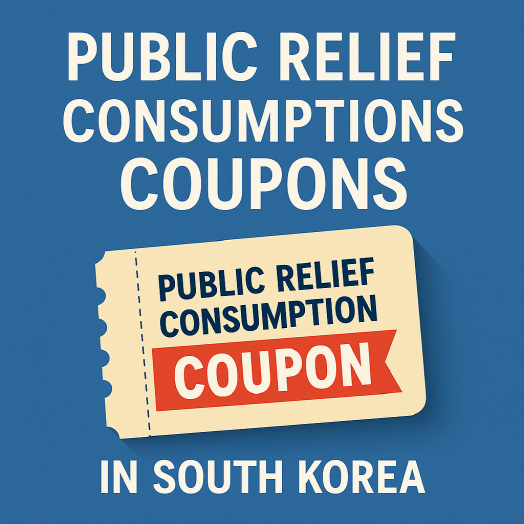
President Lee Jae-myung has recently introduced a public stimulus initiative known as the “Public Relief Consumption Coupons” to revitalize domestic consumption and support everyday citizens amid prolonged economic stagnation. These coupons are either distributed universally or targeted to specific groups such as low-income households, the elderly, or families with children, and can be used in key consumer sectors like dining, culture, tourism, traditional markets, and small businesses. The policy aims to achieve a twofold effect: invigorating consumer demand while also providing practical aid to vulnerable populations.

This type of economic stimulus is not entirely new in Korea. During the COVID-19 pandemic, similar coupon programs had a measurable short-term impact. They helped boost household spending and temporarily uplifted struggling industries. Furthermore, the transition from paper coupons to digital formats such as prepaid cards or mobile apps has increased accessibility, transparency, and convenience. These advantages have earned favorable responses from the public.

However, several concerns remain. Critics argue that the effect may be uneven, benefitting only select sectors while neglecting broader structural issues. Some economists caution that such programs may not address deeper challenges like youth unemployment, stagnant wages, or the widening gap between large corporations and SMEs. Others question the long-term sustainability of continuing such policies, particularly in light of Korea's aging population and growing fiscal burden. There are also political debates about whether these measures are merely populist tactics or genuine welfare policies.

Ultimately, the effectiveness of the Public Relief Consumption Coupons will be judged not just by short-term spending data but by how well they address the public’s daily needs and restore confidence in the economy.

What do you think?
My Take:
A commonly raised criticism is that although the policy was designed to support small businesses and boost the local economy, it has not significantly altered consumer behavior. Instead of encouraging new or additional spending, the coupons are often used to cover existing daily expenses, resulting in minimal impact on overall consumption patterns.

While promotional materials suggest scenarios like “gathering the whole family for a special dinner using the coupons,” such narratives may reflect an outdated perspective more fitting for the 20th century. In reality, most people simply apply the coupons to routine purchases such as lunch.

Like any policy, the public relief coupons come with both advantages and limitations.
Summary: One-sentence ComparisonThe Linux Master is a national certification managed by the Korea Information and Communication Promotion Association (KIPA), composed of two levels (Level 1 and Level 2), with a…
When traveling abroad or taking a domestic flight, one of the things we worry about the most is baggage regulations. In particular, it is often confusing whether hairspray, which is…
!!! Warning: This article does not constitute investment advice. Any trading losses are the responsibility of the investor. !!! The Aftermath of the Half-Line Breakdown As of October 22, Bitcoin…
Korea’s remarkable economic rise over the past half-century has been driven largely by rapid urbanization. Cities like Seoul, Busan, and Incheon became engines of growth, drawing millions from rural areas…
One of the most striking changes in modern Korean society is the rapid rise of single-person households. While traditional Korean culture has long emphasized family units and multigenerational living, today…
At first, I thought it was just a weird doll. Scary teeth, lumpy fur, and overly large, empty eyes.But once you look at it, you are strangely drawn to it….
To provide the best experiences, we use technologies like cookies to store and/or access device information. Consenting to these technologies will allow us to process data such as browsing behavior or unique IDs on this site. Not consenting or withdrawing consent, may adversely affect certain features and functions.
Functional
Always active
The technical storage or access is strictly necessary for the legitimate purpose of enabling the use of a specific service explicitly requested by the subscriber or user, or for the sole purpose of carrying out the transmission of a communication over an electronic communications network.
Preferences
The technical storage or access is necessary for the legitimate purpose of storing preferences that are not requested by the subscriber or user.
Statistics
The technical storage or access that is used exclusively for statistical purposes.The technical storage or access that is used exclusively for anonymous statistical purposes. Without a subpoena, voluntary compliance on the part of your Internet Service Provider, or additional records from a third party, information stored or retrieved for this purpose alone cannot usually be used to identify you.
Marketing
The technical storage or access is required to create user profiles to send advertising, or to track the user on a website or across several websites for similar marketing purposes.