Hairdresser evaluates hair-related skills such as haircutting, perming, and dyeing, and is essential for beauty salon operation and employment.
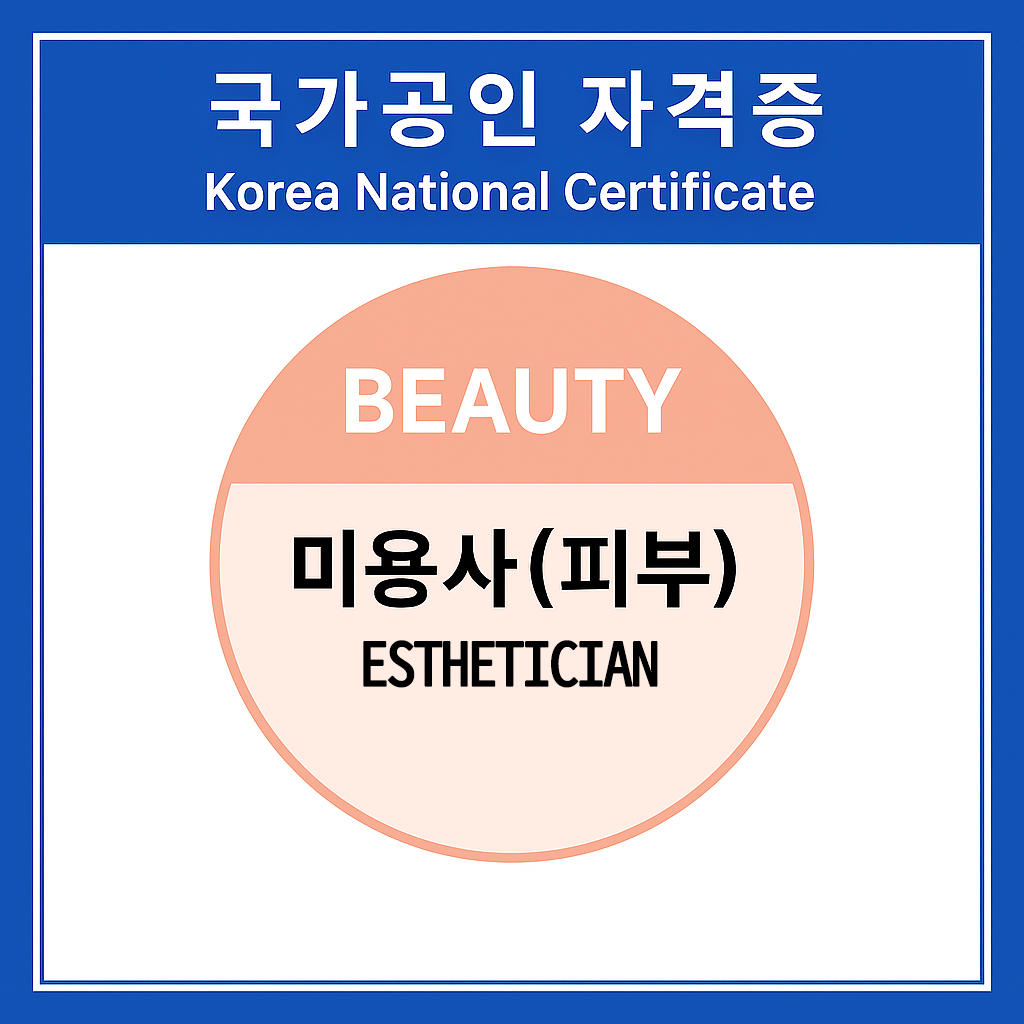
Esthetician (Skin Care) focuses on skin care and aesthetic techniques including massage, masks, and use of electric devices.
Makeup Artist assesses makeup application skills for daily, stage, and broadcast settings, and is widely used in department stores and media industries.
Nail Technician evaluates skills in nail care, gel application, tip extension, and hygiene management for professional nail services.
Detailed Description of Esthetician (Skin Care)

The Esthetician (Skin Care) certificate is a national technical qualification in Korea that evaluates theoretical and practical competencies required for professional skin care. It is managed by the Human Resources Development Service of Korea (HRD Korea) and is widely used for establishing skincare salons, working in dermatology clinics or spa centers, and fulfilling graduation or employment requirements for beauty majors. The main test-takers include students in esthetics or beauty colleges, vocational trainees, and individuals in their 20s to 40s, including foreign nationals who wish to legally work in the beauty field in Korea. The exam consists of a written and a practical test. The written test covers public sanitation, dermatology, anatomy and physiology, skin care equipment, and cosmetics theory, while the practical test evaluates hands-on abilities in cleansing, skin care routines, facial masks, massage, hair removal, use of electric beauty devices, and hygiene compliance. The practical exam is conducted in a setting similar to an esthetic salon and assesses candidates based on their table setup, model preparation, accurate use of equipment, and adherence to hygiene standards. The exam duration is approximately 60 minutes for the written test and 2 hours for the practical test, and the fees are KRW 11,900 (written) and KRW 33,000 (practical) as of 2024. This certification is mandatory for working in or opening a skin care business such as esthetic salons, dermatology clinics, hotel spas, or franchise beauty chains. With the global rise of K-beauty, the number of foreign applicants has also steadily increased. Notably, foreign nationals may use this certification to satisfy part of the requirements for F-2 (residency), F-4 (overseas Korean), and E-7 (skilled employment) visa applications. As the practical test involves live demonstrations, thorough practice and time management are critical. Mastery of esthetic equipment usage and hygiene protocols plays a decisive role in success.
Editor’s Comment

The Esthetician (Skin Care) certificate is an essential qualification for those aiming to enter the field of professional skincare and aesthetics. As the Korean beauty industry expands, the number of foreign applicants is also growing. Many real-world workplaces—like esthetic salons, dermatology clinics, and spas—explicitly require this national license, making it both a gateway and a foundation for employment. Since the practical test involves working on live models and adhering to professional standards, repeated practice and familiarity with industry-level procedures are key. It is increasingly recognized not just as a technical certificate, but also as a core credential for employment, graduation, and visa eligibility. While not highly difficult in content, the amount of practical training required can vary significantly, so candidates are recommended to pair training courses with hands-on preparation.
Korea’s remarkable economic rise over the past half-century has been driven largely by rapid urbanization. Cities like Seoul, Busan, and Incheon became engines of growth, drawing millions from rural areas in search of opportunity. But this transformation has also created a widening divide between urban and rural communities. Today, the contrast between metropolitan Korea and…
In recent years, Korea’s MZ generation—a term combining Millennials (born 1981–1996) and Generation Z (born 1997–2010)—has emerged as the most influential consumer group, reshaping industries, markets, and cultural values. Known for their digital fluency, individualism, and pursuit of self-expression, they are driving a profound shift in how Koreans spend money. From luxury goods and resale…
The Ministry of Economy and Finance (MOEF) announced on December 24 a new tax incentive package aimed at stabilizing the foreign exchange market and correcting structural imbalances in capital flows. The measures are designed to address heightened FX volatility caused by the rapid increase in overseas investments by individual investors and to encourage the repatriation…
!!! Warning: This article does not constitute investment advice. Any trading losses are the responsibility of the investor. !!! The 116K Rejection and the Market’s Next Test Bitcoin has once again tested the critical 116K resistance zone but failed to break through, marking the second consecutive day of rejection. The move underscores just how strong…
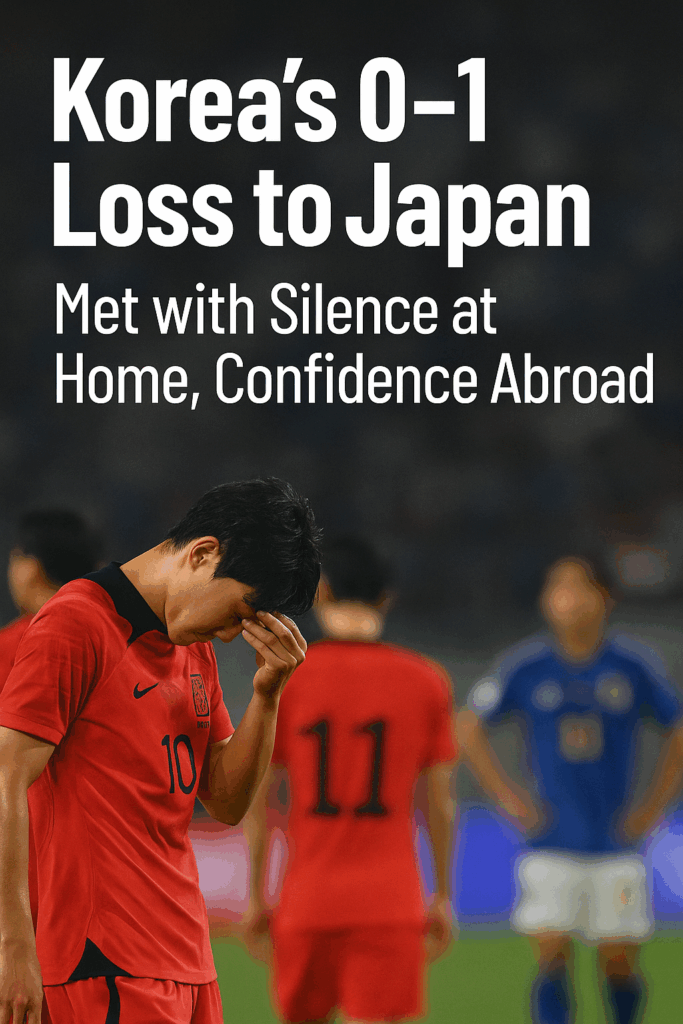
South Korea fell 0–1 to Japan in the 2025 EAFF E‑1 Championship men’s final on July 15 at Yongin Mireu Stadium. The match was decided early when Ryo Germain scored in the 8th minute, connecting cleanly with Yuki Soma’s cross. Despite having more total shots (9 to Japan’s 4), Korea managed only one on target—a…
■ The Limits of Domestic Markets: Why “Staying Put” No Longer Works As domestic markets reach structural saturation, companies are increasingly turning their attention overseas in search of growth. According to McKinsey’s analysis of Asia’s economic transformation, emerging markets are experiencing rapid expansion driven by a growing middle class and rising consumer purchasing power. Southeast…
To provide the best experiences, we use technologies like cookies to store and/or access device information. Consenting to these technologies will allow us to process data such as browsing behavior or unique IDs on this site. Not consenting or withdrawing consent, may adversely affect certain features and functions.
Functional
Always active
The technical storage or access is strictly necessary for the legitimate purpose of enabling the use of a specific service explicitly requested by the subscriber or user, or for the sole purpose of carrying out the transmission of a communication over an electronic communications network.
Preferences
The technical storage or access is necessary for the legitimate purpose of storing preferences that are not requested by the subscriber or user.
Statistics
The technical storage or access that is used exclusively for statistical purposes.The technical storage or access that is used exclusively for anonymous statistical purposes. Without a subpoena, voluntary compliance on the part of your Internet Service Provider, or additional records from a third party, information stored or retrieved for this purpose alone cannot usually be used to identify you.
Marketing
The technical storage or access is required to create user profiles to send advertising, or to track the user on a website or across several websites for similar marketing purposes.