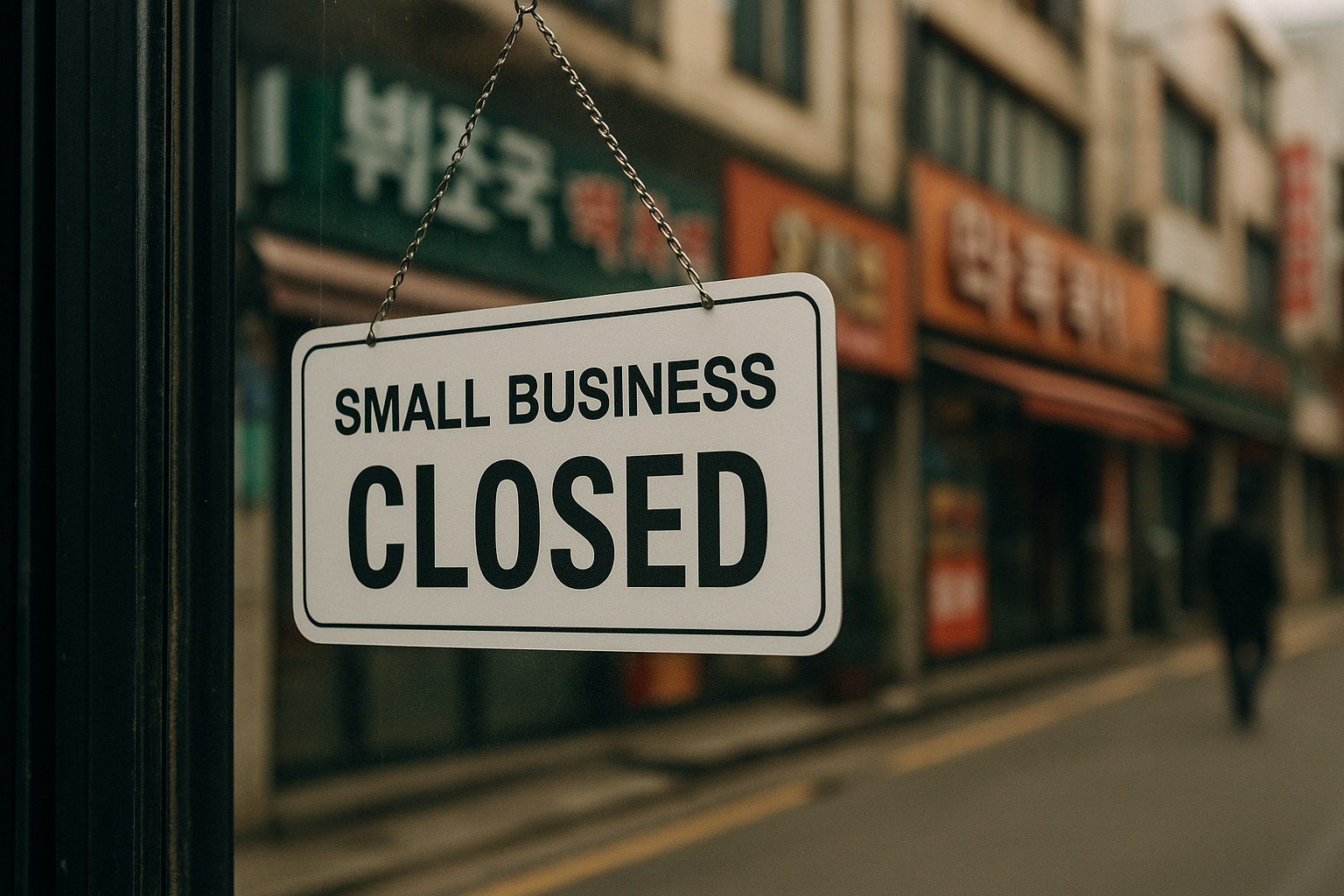
South Korea is experiencing a surge in small business closures as household spending continues to shrink under the burden of high inflation and elevated interest rates. According to the National Statistical Office, the number of self-employed businesses shutting down has increased steadily over the past year, with restaurants, cafés, and small retailers suffering the most. These businesses, which have long supported local communities, now face mounting pressures from rising rents, labor costs, and sluggish consumer demand.

Recent trends show that more Korean households are choosing to invest their money overseas in foreign stocks and cryptocurrencies such as Bitcoin. This outward flow of capital has tightened liquidity within the domestic market, making it harder for local businesses to stay afloat. Industry experts warn that unless there is meaningful relief through lower interest rates or global market stabilization, the slowdown in consumer spending may persist, putting further strain on Korea’s self-employed sector.

Analysts also point to the need for broader policy measures to support small businesses during this challenging period, including easing of loan terms, targeted subsidies, and programs to stimulate local consumption.
My Take:
In my view, the reason Koreans are tightening their wallets at home is because significant capital is flowing into foreign stocks and Bitcoin. People feel they must invest aggressively to protect their money’s value as inflation rises. I believe Korea’s local economy may only revive when the global economy stabilizes and interest rates start to come down. Until then, many small businesses will likely continue to struggle.
(This is a personal opinion, not financial advice.)

What do you think? Is a rate cut enough to revive Korea’s self-employed sector, or does the country need deeper changes to boost consumer confidence? Share your thoughts below!
The Korean government’s plan to lower the threshold for defining a major shareholder—from KRW 5 billion (approx. USD 3.8 million) to KRW 1 billion (approx. USD 760,000)—is sparking strong opposition from domestic retail investors. The move, which would significantly expand the number of investors subject to capital gains tax, is part of the Ministry of…
In recent years, Korea’s MZ generation—a term combining Millennials (born 1981–1996) and Generation Z (born 1997–2010)—has emerged as the most influential consumer group, reshaping industries, markets, and cultural values. Known for their digital fluency, individualism, and pursuit of self-expression, they are driving a profound shift in how Koreans spend money. From luxury goods and resale…
⚠️ This article is intended for informational purposes only. For actual legal issues, please consult a licensed attorney. The number of foreign workers in Korea has steadily increased each year. As of 2024, more than 900,000 foreigners are legally employed in Korea, forming an essential part of the country’s industrial workforce. Yet, due to language…
When people think of Korea, they often imagine high-speed internet, cutting-edge smartphones, and students studying late into the night. These images are not wrong—Korea has one of the fastest rates of technology adoption in the world, and education has always been a top priority for families. But when these two realities collide, challenges emerge. The…
(Field Report / by Peter Kim, Korea-based journalist)* This content is not an advertisement and is based on a fun experience. Twitter’s new AI chatbot Grok, developed by xAI, Elon Musk’s artificial intelligence company, has quickly become one of the most talked-about AIs online. Even its name sounds provocative — and rightly so. Unlike ChatGPT…
The South Korean government officially launched its “Public Relief Coupon Program” this week, aiming to boost consumer spending and help citizens cope with rising living costs.The program, announced by the Ministry of Economy and Finance, provides households with discount coupons and purchase subsidies for essential goods, cultural events, local markets, and travel. It is part…
To provide the best experiences, we use technologies like cookies to store and/or access device information. Consenting to these technologies will allow us to process data such as browsing behavior or unique IDs on this site. Not consenting or withdrawing consent, may adversely affect certain features and functions.
Functional
Always active
The technical storage or access is strictly necessary for the legitimate purpose of enabling the use of a specific service explicitly requested by the subscriber or user, or for the sole purpose of carrying out the transmission of a communication over an electronic communications network.
Preferences
The technical storage or access is necessary for the legitimate purpose of storing preferences that are not requested by the subscriber or user.
Statistics
The technical storage or access that is used exclusively for statistical purposes.The technical storage or access that is used exclusively for anonymous statistical purposes. Without a subpoena, voluntary compliance on the part of your Internet Service Provider, or additional records from a third party, information stored or retrieved for this purpose alone cannot usually be used to identify you.
Marketing
The technical storage or access is required to create user profiles to send advertising, or to track the user on a website or across several websites for similar marketing purposes.